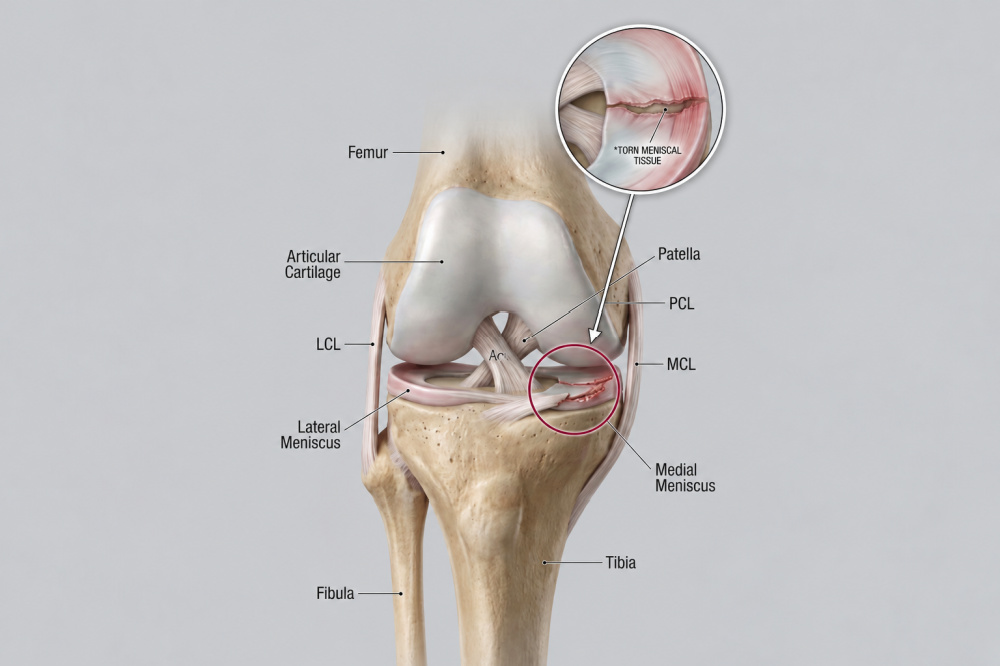
Meniscus Injuries

Meniscus Tear Rehabilitation

Whether your goal is walking comfortably, returning to work, getting back to the gym or stepping onto the sports field again, we can help you move forward with a structured rehabilitation plan.

If you have injured your meniscus, whether it is a small or large tear or you are recovering after meniscus surgery, the right rehabilitation programme can make a huge difference. At New Lynn Physio we use personalised rehabilitation plans, hands on treatment, objective strength testing and education at every stage to help you achieve YOUR goals.

The meniscus is a C-shaped piece of cartilage that acts as a shock absorber between your thigh bone and shin bone. It helps distribute load through the knee, improves stability and protects the joint surfaces. Meniscus injuries commonly occur during twisting or pivoting movements in sport, but they can also develop gradually through age-related wear and tear.

How meniscus rehabilitation works

Meniscus rehabilitation is a progressive, criteria-based programme designed to reduce pain, restore movement, rebuild strength and help you confidently return to your normal activities. Whether your injury is being managed conservatively or following surgery, we progress your rehabilitation based on your symptoms, function and objective testing using VALD technology (force plates and dynamometry).

  1. Early recovery: reduce pain and swelling, restore knee movement and normal walking. Where pain or swelling is limiting muscle activation, especially after surgery, we may use neuromuscular electrical stimulation (NMES, e.g. Compex) to help restore quadriceps function, or blood flow restriction (BFR) training to build strength safely with lighter loads while your knee recovers.
  2. Strength and control: improve quadriceps, hamstring and hip strength while restoring balance and movement quality
  3. Return to higher loads: progress to hiking, running, jumping, agility and sport-specific exercises
  4. Return to sport or recreation: build confidence and safely return to the activities that matter most to you

Frequently asked questions

A meniscus tear is damage to one of the two cartilage cushions inside the knee. Tears vary from small stable tears that heal well with rehabilitation to larger or displaced tears that may require surgery. Your physiotherapist can help determine the type of injury and whether further imaging or specialist referral is needed.

No, most meniscus injuries can settle with a well-structured rehabilitation programme alone. Surgery is generally considered if your knee is locking, catching or not responding to the appropriate rehab.

Recovery depends on the type of tear, your age, activity level and whether surgery is required.

  • Minor or stable tears: approximately 6–12 weeks
  • Larger tears managed conservatively: often 3–6 months
  • Following meniscus repair surgery: approximately 4–6 months before returning to higher-level sport
  • Following partial meniscectomy: many people return to normal activities within 6–12 weeks

Your rehabilitation will always be guided by achieving milestones.

Rehabilitation begins by settling pain and swelling while restoring full knee movement and a normal walking pattern. As your symptoms improve, we focus on rebuilding strength, balance and movement control. The last step is ensuring your knee is ready for sports and other demanding tasks.

This will be dictated by your surgeon and physio based on the achievement of key milestones. Generally, you can begin a return-to-running programme once you have:

  • Minimal pain and swelling
  • Full or near-full knee movement
  • Good single-leg balance and control
  • Sufficient lower limb strength
  • Comfortable walking and stair climbing

Return to sport is based on meeting objective rehabilitation criteria rather than time alone. This includes restoring strength, completing functional hop and balance testing, demonstrating good movement quality and having confidence in your knee during sport-specific activities.

Some meniscus tears can heal or become symptom-free with rehabilitation, particularly those on the outer edge of the meniscus where there is a better blood supply. Other tears may not fully heal but can still become pain-free and allow a full return to activity with appropriate rehabilitation.

Your physiotherapist will help decide if this is an option for you and will refer you on to our network of surgeons.

Common symptoms include pain along the joint line of the knee, swelling, clicking, catching, locking or difficulty fully straightening or bending the knee. If you’re experiencing these symptoms, an assessment with one of our physiotherapists can help determine whether your meniscus is involved and guide the next steps in your recovery.

Neuromuscular electrical stimulation (NMES, sometimes known by the brand name Compex) uses electrical currents to trigger a muscle contraction, helping restore quadriceps activity when pain, swelling or surgery has made it difficult to activate them properly. Blood flow restriction (BFR) training uses a cuff to partially restrict blood flow during light exercise, allowing you to build meaningful strength using much lighter loads, useful in the early stages of recovery when your knee isn’t ready for heavier training. Both are backed by research as effective additions to standard exercise-based rehab.

Contact New Lynn Physio to book your rehab assessment and take the next step,
reclaiming your knee and rebuilding your confidence!