
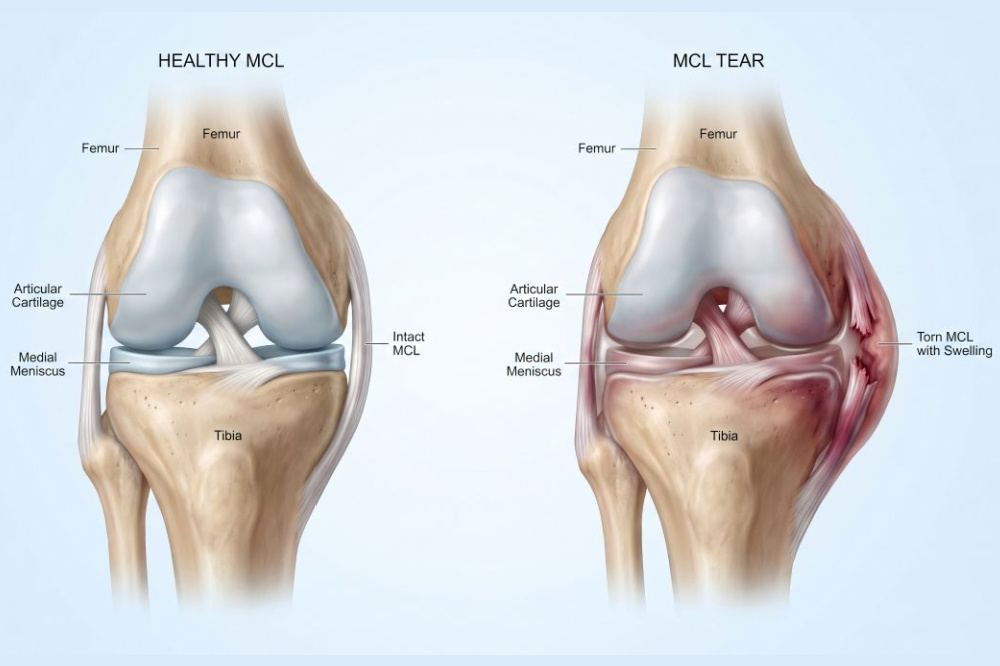
The medial collateral ligament (MCL) and lateral collateral ligament (LCL) sit on the inside and outside of the knee respectively.
Their role is to prevent abnormal bending motions and control twisting movements. These ligaments are typically injured from a direct force to the inside or outside of the knee.
Most of the time, a good physiotherapy programme is all you need to get you back performing at your best. We will work with you to develop a progressive mobility, strength and balance programme to get you achieving your goals.
Common symptoms
- Pain on the inside (MCL) or outside (LCL) of the knee
- Swelling around the joint
- A feeling of the knee “opening up” or being unstable when weight-bearing
- Tenderness directly over the ligament
- Difficulty fully bending or straightening the knee
How we assess an MCL or LCL injury
Your physiotherapist will take a detailed history of how the injury occurred and perform specific hands-on stability tests to assess the ligament and grade the severity of the injury (mild sprain through to complete tear). Where needed, we’ll guide you towards imaging or a specialist referral, though most MCL and LCL injuries are managed very successfully without surgery.
This makes an accurate initial assessment particularly important, your physiotherapist will help determine the grade of your injury and the most appropriate treatment pathway for you.
Our approach to treatment
- Early recovery: protect the ligament, settle pain and swelling, and restore normal walking. If pain or swelling makes it hard to activate your muscles properly, we may use neuromuscular electrical stimulation (NMES, e.g. Compex) to help restore quadriceps activation, or blood flow restriction (BFR) training to build strength safely using lighter loads.
- Strength and control: rebuild strength through the knee, hip and lower limb, along with balance and stability work
- Return to higher loads: progressive strengthening, agility and sport-specific training
- Return to sport or activity: confirming your knee is strong and stable enough to return to full training and competitioner than ACL rehabilitation: many people managed conservatively return to sport-specific activity within 2–3 months, while those requiring surgical reconstruction typically take longer, often 6–7 months before returning to full sport.